The USA Up Close: From the Atlantic Pact to Bush by Guilio Andreotti
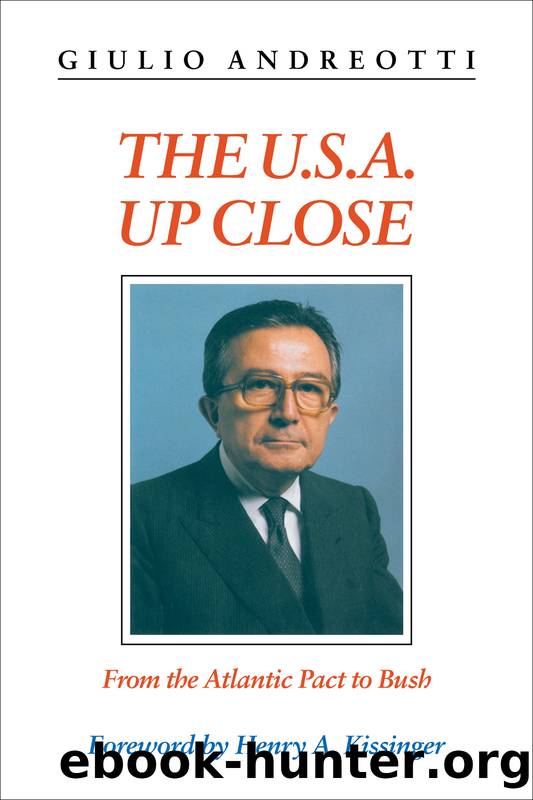
Author:Guilio Andreotti [Andreotti, Guilio]
Language: eng
Format: epub
Tags: Political Science, General
ISBN: 9780814706275
Google: gcXATnaZKW8C
Goodreads: 863708
Publisher: New York University Press
Published: 1993-08-01T00:00:00+00:00
Such a statemént was all the more important from a political standpoint since the climax of the conference had been Yassir Arafatâs speech, so enthusiastically applauded. Outside of rigid government discipline (he only met with Foreign Minister Colombo, and not even at the Ministry) everyone felt that it was not by keeping the PLO in a ghetto that the Middle East problem could be unraveled. And the time had come for a bold change of course since, at the recently attended Arab Conference in Fez, Arafat had made moderate statements (that he repeated in Rome), and looming ahead were prospects for a breakthrough that it would have been wise to cultivate. Yet, neither Washington nor London consented to receive the Fez Committee, thus unfortunately postponing the onset of a solution.
The ninety delegations also attended an audience in the Vatican where John Paul II delivered a significant address: âLiberty is a single prism of which religious freedom is but one facet. Without religious freedom there is no liberty, and without global liberty there is no religious freedom.â
There were also two Interparliamentary Union sessions in 1983. In January the U.S. delegation included Clement Zablocki (House Foreign Affairs Committee chairman), E. Kika de la Garza, Donald Pease, Bill Nelson, Bruce Vento, William Broonfield, Robert Lagomarsino, Larry Winn, and Mario Castillo. We had a thorough discussion on security problems and economic issues. Our American colleagues, who were tempted every year to curtail U.S. military spending in Europe, openly asked us if we were planning to shoulder a greater share of the burden on account of our fairly good production and growth rates. I recall that at the end of a . . . verbal skirmish full of concrete facts and figures, the head of delegation asked us: âAre the Italian people at least grateful for this American effort?â
Zablocki, of Polish origin, was quite anxious to hear any information we had from Warsaw; and naturally what he most appreciated about his visit to Rome was the opportunity to meet his (and our) Pope. He spoke to me about the development of Polish communities in the United States, especially in Chicago, with a rising birth rate most promising for their future importance. As an adamant anti-Communist, he saw no possible evolution on the horizon and considered unrealistic the hopes Edward Gierek had shared with me a few years earlier, and which I had relayed to him.
Once again our visitors appreciated and praised the climate of cooperation which reigned among Italian parliamentarians, both within the Union and on the Foreign Affairs Committee. It seemed strange to them, accustomed as they were to thinking of Italy as the theater of endless battles between Guelphs and Ghibellines or among conflicting political colors.
When the thirty-two members of the congressional delegation led by Claiborne Pell came in August, I no longer received them at Parliament, but at the Farnesina (Foreign Ministry) since, after the elections, I had become foreign minister in Bettino Craxiâs cabinet. Naturally enough, the first question focused on the meaning of this new turn in Italian politics.
Download
This site does not store any files on its server. We only index and link to content provided by other sites. Please contact the content providers to delete copyright contents if any and email us, we'll remove relevant links or contents immediately.
| Anthropology | Archaeology |
| Philosophy | Politics & Government |
| Social Sciences | Sociology |
| Women's Studies |
The Secret History by Donna Tartt(19090)
The Social Justice Warrior Handbook by Lisa De Pasquale(12190)
Thirteen Reasons Why by Jay Asher(8912)
This Is How You Lose Her by Junot Diaz(6887)
Weapons of Math Destruction by Cathy O'Neil(6281)
Zero to One by Peter Thiel(5802)
Beartown by Fredrik Backman(5755)
The Myth of the Strong Leader by Archie Brown(5508)
The Fire Next Time by James Baldwin(5446)
How Democracies Die by Steven Levitsky & Daniel Ziblatt(5219)
Promise Me, Dad by Joe Biden(5154)
Stone's Rules by Roger Stone(5088)
A Higher Loyalty: Truth, Lies, and Leadership by James Comey(4964)
100 Deadly Skills by Clint Emerson(4926)
Rise and Kill First by Ronen Bergman(4789)
Secrecy World by Jake Bernstein(4753)
The David Icke Guide to the Global Conspiracy (and how to end it) by David Icke(4720)
The Farm by Tom Rob Smith(4514)
The Doomsday Machine by Daniel Ellsberg(4490)
